

CWU's H&S Policy Adviser Points Out Malta Is A Leader In Protecting Workers from Climate Risk
Climate Change international seminar held in Palermo presented with Malta's stance on protecting workers
CWU remains involved in persuing worker and workplace protection from heat and all aspects of climate change, whilst Unionsafety continues to report on the issues involved and the campaigns and evidence buulding from Trade Unions, climate scientists, and the llegislative perfomance of Government's and countries.
 Here, James McGovern, CWU's Health & Safety Policy Adviser alerts Unionsafety to the stance of Malta as one of the first European countries to tackle Climate Change:
Malta has reinforced its standing as a frontrunner in shielding workers from the effects of climate change, after Minister for Infrastructure, Planning and Labour Jonathan Attard presented the country's model at an international seminar in Palermo.
Speaking to delegates from multiple countries, Minister Attard said Malta was among the first nations to link climate change directly to occupational health and safety policy. He pointed to a new Occupational Health and Safety Authority (OHSA) law — the first update in over two decades — alongside targeted rules on heat stress and severe weather, public awareness drives, free training programmes and active enforcement.
According to Attard, Malta's approach rests on combining scientific data, dialogue with social partners, legislation and administrative tools with ongoing training and awareness efforts. He argued this has allowed Malta to stay ahead of international debate while keeping the system flexible enough to respond to new climate-related risks as they emerge.
Construction Sector in Focus
The seminar paid special attention to construction workers, who face some of the highest exposure to heat and sun. Attard detailed a 2025 Administrative Instrument requiring employers to provide drinking water, shade, sun protection and rest areas, with stricter measures kicking in once temperatures pass 40°C.
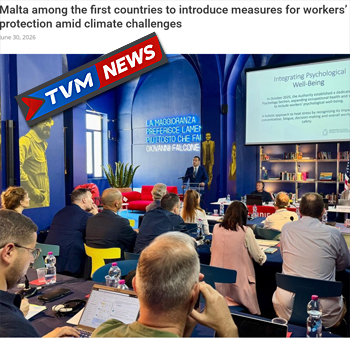 A second, more recent Administrative Instrument covers preparation, response and recovery during severe weather, including halting outdoor work, roof work and scaffolding work when severe weather warnings are issued.
Attard also noted Malta is now folding psychological wellbeing into its health and safety framework, acknowledging that heat and extreme conditions can affect workers' focus and decision-making, not just their physical safety.
"Extreme heat is no longer just a seasonal challenge, but a challenge for workplaces, public health and climate change adaptation policy," Attard said, adding that Malta chose to act early with concrete, worker-focused measures.
Praise from OHSA Leadership
OHSA CEO Dr Josianne Cutajar said Malta's presence in Palermo reflected growing international recognition of its work, and that the country's mix of legislative, administrative, educational and enforcement measures shows a genuine commitment to putting worker protection at the heart of national policy.
OHSA Board Chairman Pierre Fava said the presentation confirmed Malta's advanced position on climate change and occupational safety.
The seminar was also attended by GWU Government and Public Entities Section Assistant Secretary Gorg Zahra and Anthony Casaru, representative of the Confederation for Health and Safety, For.U.M.
Addendum: The Wider Context
A separate April 2026 analysis underscores why Malta has moved early on this issue. Malta's position in the central Mediterranean puts it in a region recognised internationally as a climate hotspot, warming faster than the global average, with heatwaves projected to grow more frequent and intense. Long-term records show the trend is already well underway: between 1952 and 2020, average maximum temperatures in Malta rose by 1.5°C and average minimum temperatures by 1.4°C.
The same piece notes that warmer nights reduce the recovery time outdoor workers get before the next day's heat, compounding stress from physical exertion and protective clothing. Beyond construction, this is flagged as a material concern for utilities, road maintenance and municipal services. Sector figures quoted in the analysis argue that OHSA's rules on risk assessments, contingency planning, suspending work in extreme conditions and structured return-to-work procedures are necessary adaptations — and that workers slowing down in extreme heat reflects a genuine physiological response, not underperformance.
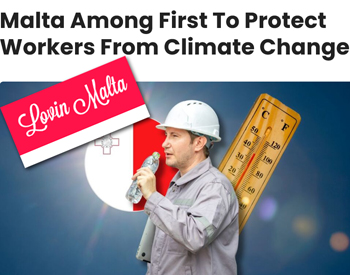 It is worth looking at Malta’s thorough assessment in that April 2026 document relates to the country’s wider evaluation and consideration to the fat that warmer nights reduce the recovery time outdoor workers get before the next day's heat, compounding stress from physical exertion and protective clothing. Beyond construction, this is flagged as a material concern for utilities, road maintenance and municipal services.
Sector figures quoted in the analysis argue that OHSA's rules on risk assessments, contingency planning, suspending work in extreme conditions and structured return-to-work procedures are necessary adaptations — and that workers slowing down in extreme heat reflects a genuine physiological response, not underperformance.
Here's what Malta OHSA's rules actually cover, based on the two relevant instruments:
The severe/extreme weather instrument (the one referenced in the seminar) is triggered specifically when a red weather warning is issued by the competent authorities. Once triggered, it requires:
- Risk assessments and contingency plans — employers must have these in place as mandatory preventive measures, developed in response to recent severe weather events and finalised following consultation with worker and employer representatives.
- Suspension of outdoor work — this includes halting outdoor work, roofing and scaffolding activities specifically during severe weather warnings.
- Structured return-to-work procedures — the instrument sets out clear, structured procedures governing the safe return to work once conditions clear, rather than leaving it to individual judgement.
The separate heat-specific instrument (construction-focused, in force since 2025) works a bit differently — it's threshold-based rather than warning-based:
- It requires a site-specific risk assessment that factors in environmental, personal and working conditions that influence heat tolerance.
- Once the ambient temperature reaches or exceeds 40°C, as officially reported by the Meteorological Office at Malta International Airport, the project supervisor must assess site conditions and ensure appropriate protective measures are implemented.
- Those measures can include shaded rest areas, increased hydration breaks, rescheduling tasks, or partial/temporary suspension of work in direct sunlight.
In short: the heat instrument is about proactive, threshold-triggered adjustments to how work is done in the sun; the extreme-weather instrument is about a full stop-and-restart process once a red warning is issued. Non-compliance with either can lead to enforcement action under the OHSA Act.
There is no doubt that the UK’s legislation and stance on climate change and workplace temperatures much lacking in comparison, and do not support and protect workers as they need and should do.
Source: Jamie MccGovern / Chris Ingram: text and images / TVM News
